
Professional deck staining
We stain decks, porch floors, railings, steps and pergolas for homeowners across northern Delaware and the Pennsylvania townships next to it. Exterior wood needs the surface opened up before stain will hold. We wash it, let it dry properly, sand what needs sanding, and then stain.
Serving Wilmington, northern Delaware and southeastern Pennsylvania. See every area we cover.
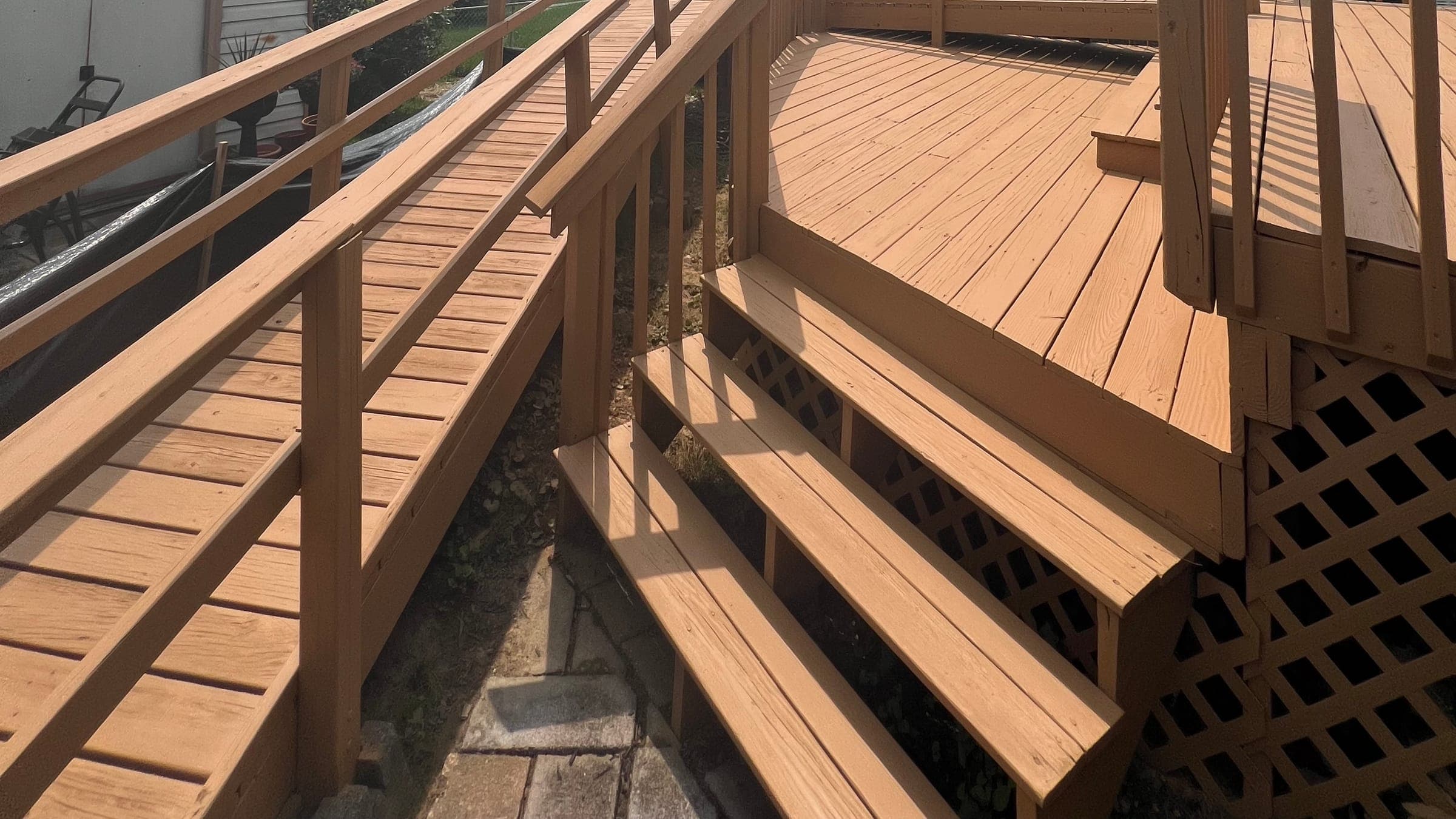
What the job covers
- Decks, porch floors, steps, railings and pergolas
- The wood washed before anything else
- Rough and weathered boards sanded
- Protruding fasteners set below the surface
- Stain or sealer worked into boards, rails and spindles
- Surrounding planting and siding protected
How it runs
Look at the wood
Some decks need stain. Some need boards replaced first, and we will say so rather than staining over a problem.
Wash
Dirt, mildew and loose old coating come off.
Let it dry, then sand
Wood has to be dry before stain goes on. Rushing this is why coatings peel.
Stain
Boards, rails and spindles, worked in properly rather than flooded on.
What the wood is, and what it wants
Stain is not paint. It goes into the wood rather than over it, so the boards decide the result far more than the product does. The first thing we do on a deck is work out what it is made of and what condition it is actually in.
Pressure treated pine
The most common deck around here and the one most often stained too early. New treated wood holds mill glaze and a lot of moisture, and stain will sit on top of that instead of going into the board. It has to be opened up first.
Cedar
Softer and it grays quickly wherever it is exposed. Cedar takes stain very well once it has been cleaned back, but it does not want aggressive washing, and a deck that has been blasted needs sanding before it needs stain.
Older hardwood boards
Dense boards shed stain when the surface has closed up with age and old coating. They need the surface opened before anything is worth applying, and they take less stain than people expect.
Composite boards
Composite decking does not take stain. If your deck is composite we will tell you that instead of selling you a coating that will not hold, and a wash is usually all it actually needs.
Railings, spindles and steps
The parts that take the hand and the weather at once. They are slower to do properly than the deck floor, they are what anybody touches first, and they are where a rushed job is obvious.
Porch floors and pergolas
A covered porch weathers completely differently from an open deck, so the same property can want two approaches on two structures ten feet apart.
When a deck is ready for stain
Most stain failures are timing failures rather than product failures. Four things have to be true before stain is worth putting on, and only one of them is the weather on the day.
Washed, then properly dry
A deck washed in the morning is not ready in the afternoon. Wood holds water inside the board long after the surface looks dry, and stain applied over that is the single most common reason a deck peels.
New wood may need to weather first
New pressure treated boards often need a season before they will take stain properly, and how long depends on the boards rather than the calendar. We check rather than guess at it.
Boards replaced before, not after
A soft or split board is carpentry, not staining. Where a deck needs boards out we say so, because staining around a board that has to come out next spring wastes the work.
Dry hours after it goes on
Stain needs settled weather behind it as well as in front of it. That is why deck work gets booked to a forecast and occasionally moved by a day.
Common questions
How soon can a new deck be stained?
New pressure treated boards often need to weather before they will take stain, and how long that takes depends on the boards rather than on the calendar. We check the wood rather than guess at a date.
Can composite decking be stained?
No. Composite does not take stain. If your deck is composite we will tell you so rather than sell you a coating that will not hold, and a wash is usually what it actually needs.
Do you stain the railings and steps as well?
Yes. Boards, steps, rails and spindles. The rails and spindles take longer to do properly than the deck floor, and they are what anybody touches first.
The deck was washed last week. Can it be stained now?
Not necessarily. Wood holds water inside the board long after the surface looks dry, and stain applied over that is the most common reason a deck peels the following year.
What if some of the boards need replacing?
We say so before staining rather than after. Staining around a board that has to come out next spring wastes both the stain and the labor that went with it.
Where the decks are
Decks go with lots and with trees. The wooded lots and large detached houses through Hockessin and Pike Creek carry most of them on the Delaware side, and the compact lots in Wilmington Manor carry compact decks with a lot of fence line beside them.
Over the line the same pattern runs out through Landenberg, where properties sit down long drives under heavy tree cover, and on into Chester Heights and Glen Mills. A shaded deck stays damp far longer than an open one, which is why the drying time matters more there than the stain does.
Deck and porch work goes out across New Castle County, Chester County and Delaware County, Pennsylvania.
What customers say
100+ reviews on Google at a 5.0 average, quoted on our reviews page as they were written.
Get a free estimate
Tell us about the project. We assess it in person, or online when that suits the job, and your written proposal follows promptly. Call or use the form, whichever is easier.
Owner-operated since 2017, not a franchise. Free estimates with no obligation and no pressure to book. When you call, we answer the phone ourselves.